3 HVAC Retrofit Mistakes That Break Projects in NYC Buildings
Jan 6, 2026
What Facility Managers and Chief Engineers should watch for before signing off
Most HVAC retrofit projects do not fail because of bad equipment.
They fail because the retrofit is planned around assumptions instead of building reality.
When those assumptions go unchecked, failure is not accidental. It is engineered into the project.
Across hospitals, labs, and large commercial buildings, the same problems appear again and again: callbacks, unstable operation, comfort complaints, and finger-pointing after startup.
We approach retrofits as operational engineering projects, not equipment swaps. From that perspective, three mistakes consistently create risk before the project even starts.
This is not theory. It is field reality.

HVAC Retrofit Mistake #1
Designing the retrofit without real measurements
Replace-like-for-like decisions based on old drawings.
Equipment sized from nameplates instead of actual airflow.
Comfort complaints immediately after startup.
Fans, coils, or motors operating outside a stable range.
Most existing buildings do not operate the way the drawings say they should.
Over time, spaces change use. Loads shift. Coils foul. Filters load up. Dampers drift. Ductwork gets modified.
When design decisions are made without a current snapshot of reality, the retrofit inherits uncertainty.
Before locking the design, capture a baseline:
Actual airflow and static pressure
Motor amps and speed
Filter and coil pressure drop
Key constraints such as power, access, and downtime windows
Even a limited pre-retrofit testing and balancing snapshot is better than none.
Facility takeaway:
If nobody measured it, you are not designing a retrofit. You are guessing.
HVAC Retrofit Mistake #2
Treating controls as an afterthought
Fans hunting or oscillating.
Alarms and nuisance trips after startup.
Dampers and fans fighting each other.
Unstable pressurization in critical areas.
Retrofits change system dynamics.
New fans, motors, or coils respond faster than legacy components. If control logic is not reviewed and updated, the system becomes unstable.
Common causes include:
Old sequences reused without validation
Sensors placed incorrectly or not calibrated
EC motor or VFD logic not aligned with system intent (Read more: EC vs AC retrofit reality in NYC)
No trend review after startup
Good hardware cannot compensate for poor control logic.
Controls must be scoped upfront, not figured out later.
Review the sequence of operation before procurement.
Align fan, damper, and sensor logic.
Define trend points and stabilization criteria.
Plan a tuning period after startup.
Facility takeaway:
A retrofit without a controls plan is unfinished by definition.
—-
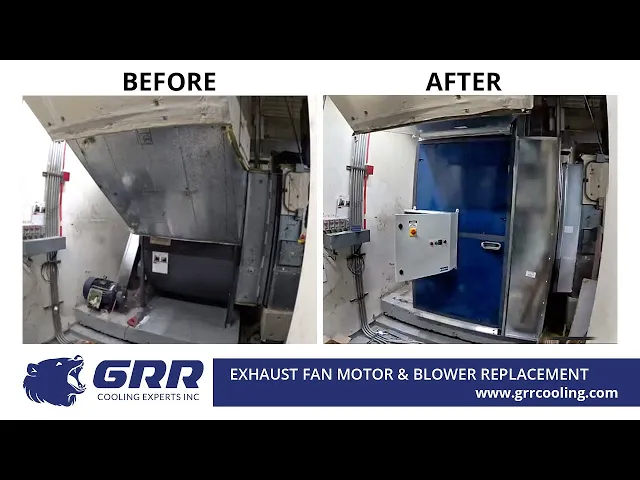
Proof of method: In April 2025, GRR Cooling Experts applied this sequence on a hospital return air retrofit, delivering 36,825 CFM at 2.0″ static pressure with six direct-drive EC fans.The system was balanced under partial load and went live with zero downtime and stable airflow from day one. (Watch Before-and-After video of that project)
More Installation cases re available on our YouTube channel>
HVAC Retrofit Mistake #3
Skipping a real commissioning plan
Endless punch lists.
Performance drifting weeks after startup.
Vendors blaming each other.
Facility teams inheriting unresolved issues.
Commissioning is often treated as a checkbox instead of a deliverable.
Without clear acceptance criteria, no one owns the final outcome.
Commissioning should answer one question:
Is the system operating as intended under real conditions?
Define upfront:
Acceptance metrics such as airflow range, static pressure, sound, and vibration
Control stability requirements
Who verifies what, and when
A post-startup verification visit
Document the final condition and hand it over clearly.
Facility takeaway:
If commissioning is not planned, callbacks are guaranteed.

What all three mistakes have in common
They are not equipment problems.
They are process problems.
Successful retrofits focus on:
Measurement before decisions
Controls as part of the system, not an accessory
Commissioning as project closure, not paperwork
Our retrofit work typically starts with measurement, controls review, and commissioning planning before equipment decisions are finalized. That sequence reduces surprises and delivers stable operation.
A simple retrofit preflight checklist
Before approving a retrofit scope, ask:
What was measured on site?
How will controls be adjusted?
How will performance be verified?
Who owns commissioning?
What happens two weeks after startup?
If these answers are unclear, risk is already built in.
Final thought
Retrofits are different from new builds. You inherit constraints, history, and operating habits. The goal of a retrofit is not perfect specifications. It is stable, predictable operation that holds under real conditions.
Why NYC buildings switch to EC fan arrays>
About GRR Cooling Experts
GRR Cooling Experts Inc. is a New York–based HVAC retrofit engineering company specializing in ventilation upgrades for hospitals, laboratories, schools, and commercial buildings.
Since 2007, our team has delivered more than 400 retrofit and service projects across the NYC metro area, improving airflow reliability, energy efficiency, and Local Law 97 compliance through precision EC fan array retrofits and critical-environment ventilation solutions.